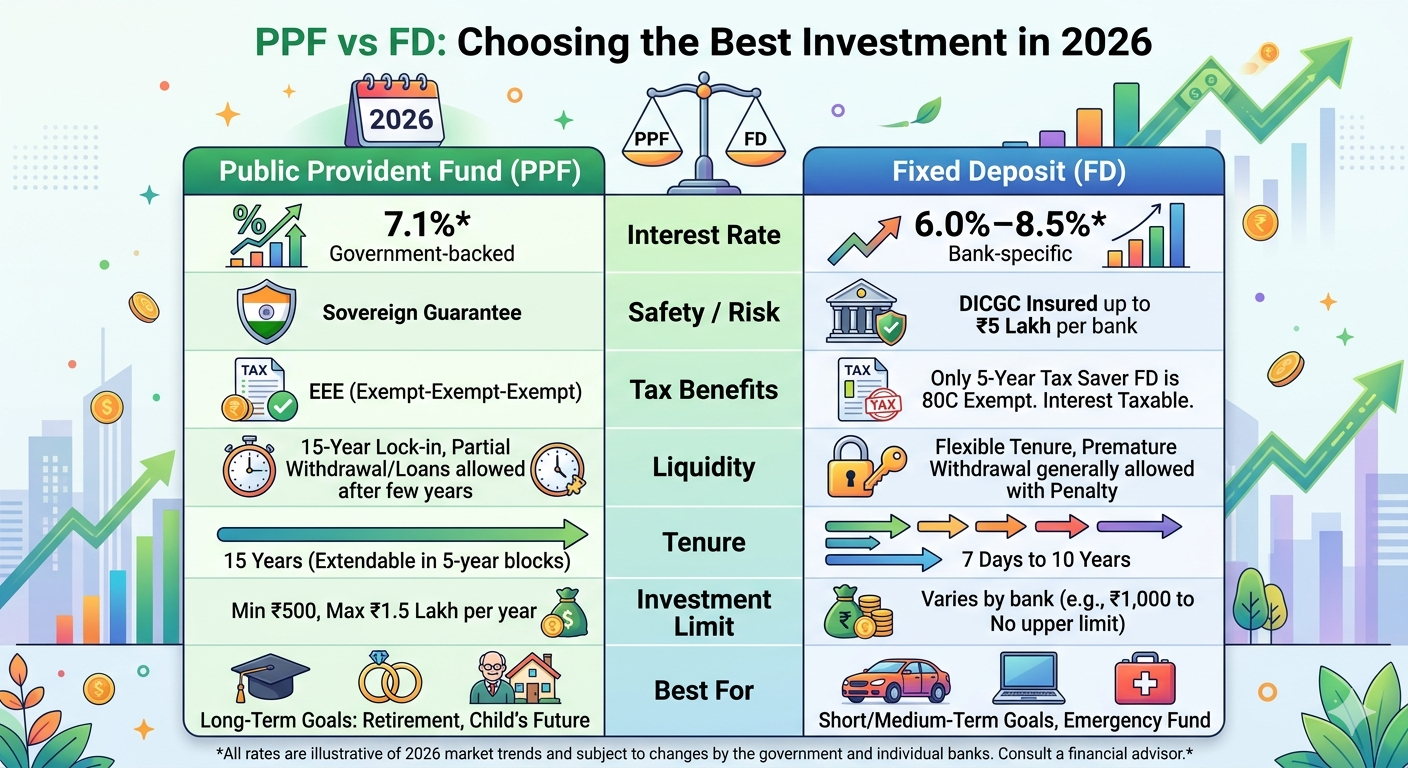
SIP vs FD India 2026 — Which Gives Better Returns?
Investment SIP vs FD — Which is Better for Indian Investors in 2026? By CalcBharat.com Finance Team · April 2026 · 9 min read
This is one of the most common financial questions in India: should I put my money in a Fixed Deposit or start a SIP in a mutual fund? Both are popular. Both have merit. But they serve very different purposes — and choosing the wrong one for your situation can cost you lakhs over time.
This guide gives you an honest, numbers-first comparison. No fluff.
The Core Difference in One Line
FD = Guaranteed return, lower growth. SIP = Market-linked return, higher long-term growth. The right choice depends entirely on your timeline and risk tolerance.
Returns Comparison — Real Numbers (2026)
| Investment | Amount | Duration | Rate | Maturity Value |
FD (SBI, quarterly)₹5,000/mo (RD)5 years6.8%₹3.56 lakh |
SIP — Large Cap Index₹5,000/mo5 years12% (hist.)₹4.12 lakh |
FD (SBI, quarterly)₹5,000/mo (RD)10 years6.8%₹8.56 lakh |
SIP — Large Cap Index₹5,000/mo10 years12% (hist.)₹11.61 lakh |
FD (SBI, quarterly)₹5,000/mo (RD)20 years6.8%₹26.1 lakh |
SIP — Large Cap Index₹5,000/mo20 years12% (hist.)₹49.9 lakh |
*SIP returns are based on historical Nifty 50 averages. Past performance does not guarantee future returns. FD rates as of April 2026.
Over 20 years, SIP gives you ₹23.8 lakh more on the same ₹5,000/month. That’s nearly double. This is the power of compounding at a higher rate over long periods.
📌 🔢 Calculate your own numbers: SIP Calculator · FD Calculator
Tax Comparison — The Hidden Difference
Returns alone don’t tell the full story. Tax treatment makes a massive difference:
| Feature | FD / RD | SIP (Equity Fund, 1yr+) |
Tax on returnsAs per income slab (up to 30%)10% LTCG above ₹1L/year |
TDS deduction10% if interest > ₹40,000/yearNone (you pay at redemption) |
Effective post-tax return (30% slab)~4.8% on 6.8% FD~10.8% on 12% SIP |
Tax-saving option5-year tax-saver FD (80C, ₹1.5L)ELSS SIP (80C, ₹1.5L, better returns) |
For someone in the 30% tax bracket, a 6.8% FD effectively returns only ~4.8% post-tax. An equity SIP at 12% returns ~10.8% post-tax (after 10% LTCG on gains above ₹1L). The gap is enormous.
Risk Comparison — What Could Go Wrong?
| Risk Factor | FD | SIP (Equity) |
Capital lossZero (DICGC insured up to ₹5L)Possible in short term |
Return uncertaintyNone — fixed at bookingHigh in short term, low over 10+ years |
Inflation riskHigh — 6.8% FD barely beats 5–6% inflationLow — equity historically beats inflation |
LiquidityPenalty on premature withdrawalCan redeem anytime (open-ended funds) |
Bank failure riskDICGC covers only ₹5L per bankSEBI-regulated, assets held separately |
When FD Wins
- Timeline under 3 years — equity SIP is too volatile for short goals
- You cannot afford any capital loss (e.g., money needed for a specific date)
- Emergency fund — needs to be safe and accessible
- Senior citizens needing regular income from interest payouts
- You’re in a low income tax bracket (below 20% slab) — tax disadvantage of FD shrinks
When SIP Wins
- Timeline 5 years or more — the longer, the more SIP wins
- Goal is wealth creation, not capital preservation
- You’re in the 20% or 30% tax slab — SIP’s tax efficiency is a huge advantage
- You want to build a retirement corpus or child’s education fund
- You can tolerate short-term volatility for long-term gains
The Verdict — Use Both, Not Either/Or
The smartest approach is not SIP vs FD — it’s SIP AND FD for different purposes:
- Emergency fund (3–6 months expenses): FD or liquid mutual fund
- Short-term goals (1–3 years): FD or debt mutual fund
- Medium-term goals (3–7 years): Hybrid/balanced advantage fund SIP
- Long-term wealth (7+ years): Equity SIP (index fund or flexi cap)
- Retirement: SIP + PPF + NPS combination
📌 📖 Next read: How to Start SIP in India — Complete Beginner Guide →
👨💼
CalcBharat.com Finance Team Investment & Banking Experts Mutual fund returns cited are historical Nifty 50 averages. Past performance does not guarantee future results. FD rates as of April 2026. Consult a SEBI-registered advisor before investing. Last updated: April 2026.
Frequently Asked Questions
Ready to calculate? Get instant accurate results.
Compare SIP vs FD ReturnsFrequently Asked Questions
SIP (equity) historically delivers 11–14% CAGR over 10+ years vs FD’s 6.5–7.5% guaranteed return. The catch: SIP has market risk. For 7+ year goals, SIP typically wins significantly. For 1–3 year goals where you can’t afford any loss, FD is the right choice.
SIP. Equity LTCG above ₹1.25L/year is taxed at 12.5%. FD interest is taxed at your full income slab rate (up to 30%). At the 30% slab, an 8% FD gives ~5.6% post-tax return. Equity SIP at 12% gives ~10.5% post-tax after LTCG. The gap is significant over time.
It works in your favour — you buy more units at cheaper prices (rupee cost averaging). A crash in early years of a 10-year SIP is actually the best thing that can happen. The worst mistake is stopping your SIP during a crash. Stay invested; the recovery compounds your low-cost units.
In rolling 7-year periods since 2000, Nifty 50 has beaten fixed deposit returns ~85% of the time. For 10-year periods it’s closer to 92%. Under 5 years, the outcome is less predictable. Match the instrument to your timeline — not just the return.
Yes — they serve different purposes. Keep 6 months’ expenses in FD/liquid fund as emergency reserve. Then direct remaining savings into equity SIP for long-term goals. This covers both safety and growth. Don’t pit them against each other; use both in the right role.